Showing posts with label musical theatre. Show all posts

Tuesday, October 20, 2015

TRAILER: The Trumpet of The Swan


Can a brass horn be the key to love? Louis, a trumpeter swan, is different from his sibling cygnets, for he was born without a voice. But with great diligence, patience, and resilience, Louis learns to play the trumpet and communicate his thoughts and feelings through the power of music. E. B. White’s award-winning story "The Trumpet of the Swan" is inspired by the natural world and our own very human need to connect and to communicate. This innovative, all-ages production features both spoken language and American Sign Language. It runs from October 23 - November 22, 2015 at Wheelock Family Theatre in Boston's Fenway neighborhood.

Wheelock Family Theatre is a professional theatre company that creates intergenerational and multicultural productions that provide a shared experience for the whole family.  Our productions celebrate the diverse range of families found in the world today and seek to unite them in the shared experience of live theatre. Learn more at wheelockfamilytheatre.org.

Purchase your tickets today!

Friday, May 8, 2015

Review Quotes! Everybody Loves Shrek!


“Wheelock's delightful and energetic Shrek sends a positive and timely message about not judging ourselves or others by what's on the outside rather than by what's on the inside. In our looks-obsessed society, it's a message that kids can't hear enough.”
-Margaret Hagemeister; Boston Events Insider

“The performance itself was… full of heart, dedication and sincerity. The ensemble cast sings and dances their hearts out, and their comedic timing is on point.”
-Meghan B. Kelly; WickedLocal.com

Wednesday, April 22, 2015

SHREK Theater Review by Anne Pieterse

“Your horny warts, your rosy wens,

Like slimy bogs and fusty fens,
Thrill me” –William Steig (from Shrek)

“Shrek” was the first, one of the many children’s picture books, artist William Steig wrote and illustrated. Then Shrek became a DreamWorks movie followed by a Broadway musical. And now tonight, “Shrek the Musical” is the final production of the Wheelock Family Theatre’s 34th season. And what a brilliant opening night performance it was. Directed by Shelly Bolman, choreographed by Patricia Manalo Bochnak, musical direction by Matthew Stern, and costume designer Charles G. Baldwin worked together to create a production filled with dazzling entertainment. There were dance numbers to get you stomping your feet, comedy for all ages, solo singing, and vibrant choral numbers, songs mixed with dance numbers, all tucked together with simple movable sets. Whether in book, film, or theatrical presentations, the story of Shrek remains the same. It is an ugly duckling tale (with a twist), an ogre named Shrek wants to be a left alone in his swap. Farquaad (the current ruler, but not yet King) is a self- impressed bully, who orders Shrek to rescue the princess Fiona so he can marry her and the become King. Battles with fire breathing dragons and “Donkey’s” wisdom, give heart to this endearing and satisfying story. The tale promotes diversity and encourages more than superficial thought when we are asked to consider what makes a princess and what characteristics her suitor should have. The story encourages us to celebrate who we are and how we do it. To look beyond the assumptions we make when judging ourselves and others.

Experienced talented actors, Christopher Chew (Shrek), Shonna Cirone (Fiona), Maurice Emmanuel Parent (Donkey), Mark Linehan (Farquaad), set the tone by their strong performances. The smaller characters roles of Young Shrek, Young and Teenage Fiona, Thelonius, Bishop, Mama Ogre, Papa Ogre, King Harold, and the Knights did superior work as well, often playing more than one part.

Shrek the Ogre just wants to be left alone in his swamp and has no interest in having fairytale trash living next to him. The “Fairytale Trash” community of creatures are easily recognized as the characters from Grimm’s fairytales, old cartoons, and Disney movies: Pinocchio, Papa Bear, Mama Bear, Baby Bear, Fairy Godmother, Red Queen, Bluebird, Genie, Little Red Riding Hood, Chip, The Teacup from Beauty and the Beast, Ariel, The Three Blind Mice, The Three Little Pigs, Ugly Duckling, Queen Lillian, Wicked Witch, Captain Hook, Pied Piper, Big Bad Crossdressing Wolf, Ginny and Peter Pan. The costumes were made with bright dazzling colors that allowed the audience to easily recognize the familiar characters. And a variety of jokes are enhanced by the audiences past history and knowledge of fairytale creatures.

The live 8 man orchestra including keyboard, 2 reeds, trumpet, trombone, guitar, bass, and drums sat under the stage and was first-rate.

The use of puppets was captivating when eight puppet handlers maneuvered the dramatic giant Dragon that towered, twisted, and turned majestically over the stage. The handlers moved as one and actually danced with the flow of the Dragon’s swirling body from the fire coming out of her mouth to the tip of her long pointy tail. Hand puppets were used too. Funny scenes involving the torture of the Gingerbread Man were hilarious. The Gingerbread Man cookie puppet ends up shouting, “Eat me!” and the audience roared.

Young children in the audience seemed to be smitten and enthralled by the sparkles, glitter, and energy of the evening. Unobtrusive open captioned, by illuminated lighting on both sides of the stage, aided in the enjoyment for those hard of hearing and deaf. Each production offers final weekend performances that are interpreted in American Sign Language and audio-described for patrons who are blind, with Braille programs available upon request. All productions offer enhancements for patrons with cognitive disabilities or sensory sensitivities. Everyone should partake, and savor the fun in this delightful show.

Friday, October 31, 2014

ALICE. a dramashop at the Eliot Pearson Children's School

Today was another day of bliss and busy fun in our kindergarten classroom. John from the Wheelock Family Theatre came and told the children the story of the play they will be seeing tomorrow. It was fantastic! He told them that the play is an adaptation of the Alice in Wonderland story, so there will be some things that will be different from the original story and from the Disney version. For one thing, the main character, Alice, is played by an African American actress, and not depicted as a blond haired, blue-eyed child. John explained that Wheelock Family Theatre strives to give its audience the chance to see people like them performing on stage. After offering a summary of the story, he asked if anyone would like to do a little acting exercise - being a caterpillar. Three children volunteered.


After today's morning meeting about riding the school bus and viewing Alice the Musical, I expect that the children are ready for our school-wide adventure and will likely have a great time tomorrow. Here are a few pictures taken during their meeting with John.

Thursday, October 23, 2014

"Alice" at Wheelock finds balance for young and old audiences

Metro Boston - 10/22/2014  -Nick Dussault
The Wheelock Family Theatre kicks off its 34th season with “Alice,” a new musical adaptation of Lewis Carroll’s classic books “Alice in Wonderland” and “Alice through the Looking Glass.”
Written and directed by 24-year-old Stoneham native (and frequent Wheelock performer) Andrew Barbato, “Alice” takes the audience on a fun trip down the rabbit hole for a coming-of-age tale that’s sure to resonate with people of all ages. Barbato's script finds a sweet spot somewhere between fairy tale and the acid trippiness of Jefferson Airplane's "White Rabbit."
Rife with humor (some of which goes right over the younger heads in the crowd), “Alice” also boasts some not-so-subtle messages including the belief that nothing is impossible, the importance of what you do for others, and the high price of perfectionism.      
While Barbato’s enthusiasm for the story is clear from the start, his narrative sometimes loses its way. In Act I you might find yourself wondering who’s who and how you got to certain places. But stick with it. By the time you get to the Mad Hatter’s tea in Act 2, everything makes sense, except, of course, the logic of the locals at the tea.
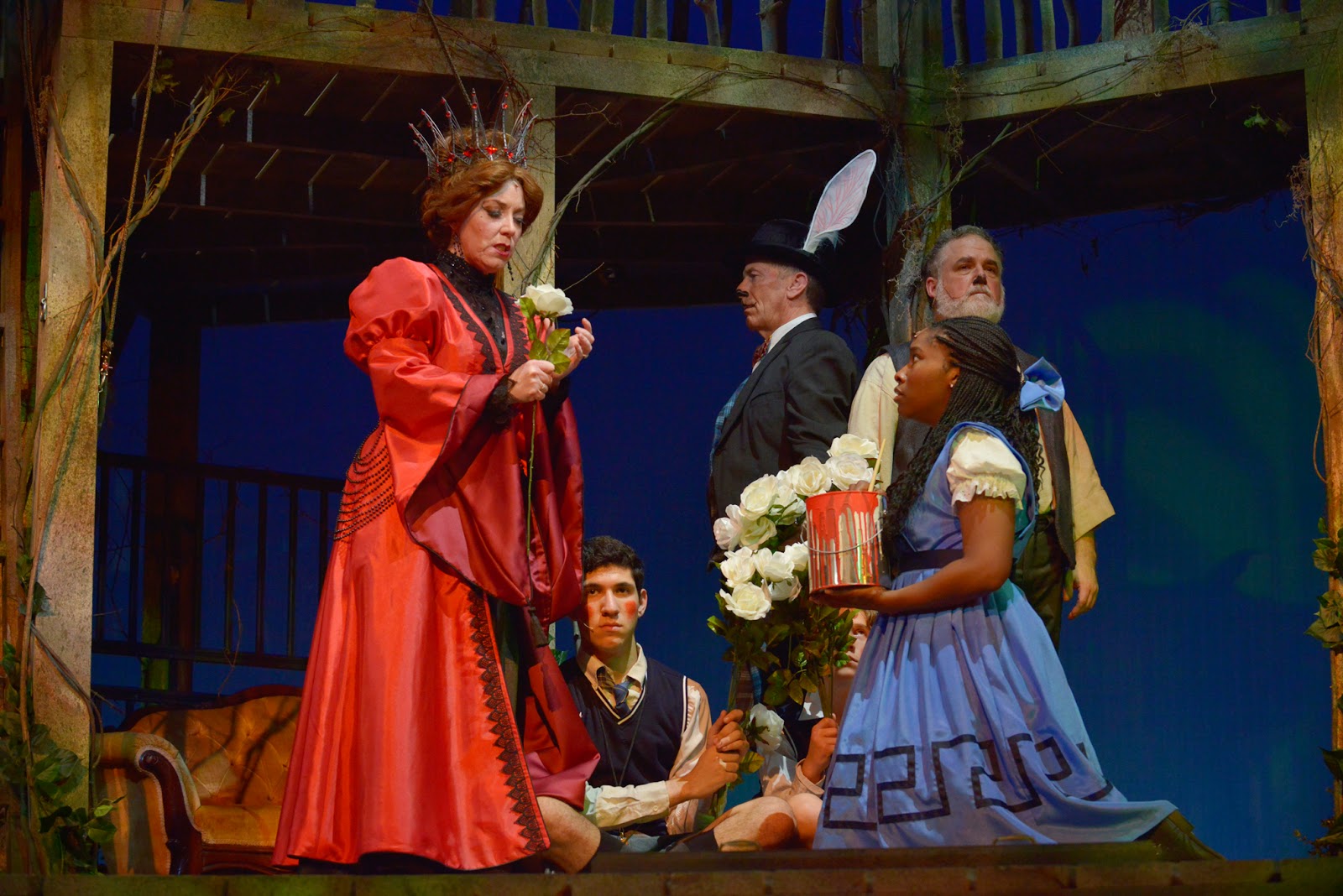
Though the music, written by Lesley DeSantis, isn’t something you’ll be singing on your way out the door, it is warm, touching and perfectly appropriate for this piece. Alice (a vocally stunning Maritza Bostic) and the Queen of Hearts (the always-impressive Leigh Barrett) share the show’s finest musical moment, a lump-in-your-throat rendition of “Paint the Roses Red.”
Aubin Wise also delivers a standout performance as the White Queen, while Alexandra Nader shines in her stellar turn as the Cook. Russell Garrett finds the perfect amount of mad for the Mad Hatter and Jenna Lea Scott shines as the Frog Footman.
Matthew Lazure’s set (which feels like it could work in a Tim Burton film) is the perfect backdrop for “Alice” while Scott Clyve’s lighting design greatly enhances the magic of Barbato’s impressive debut production.


"Alice" Performs a Mash Up at the Wheelock

Wicked Local 10/23/2014
-Iris Fanger


Lewis Carroll’s beloved classic "Alice’s Adventures in Wonderland" is about a bored little girl who falls asleep at the edge of a river and dreams of a fantastic country where she must use her wits and ingenuity to make her way. At the end, her sister wakes her on the riverbank and since she’s a child of Victorian England, she probably returns home for tea. Not so in the latest dramatic adaptation of the story,"Alice," now running at Wheelock Family Theatre.

Writer Andrew Barbato and composer and lyricist Lesley DeSantis have created a new work that discards Carroll’s simple frame to the story for a mashup of themes from "Peter Pan," "The Nutcracker" and Maurice Sendak’s "Where The Wild Things Are." Their "Alice" pictures a young girl on the brink of adolescence who must grow up and accept responsibility. This trade-off has its pluses and regrets in the Wheelock’s elaborate production filled with visual treats.

The new musical begins (and will end) in Alice’s room, on the morning of her 13th birthday. Alice (Maritza Bostic) is in bed with her cat, a sinuous, ever-adoring animal (Julia Talbot), when her mother (Leigh Barrett) enters and orders her to get dressed and ready for the party. "Don’t disappoint me, " Mother says, echoed by the character of Alice’s older sister (Jennifer Elizabeth Smith). And Mother never even wishes her daughter "Happy Birthday."

Mother’s demand is the cue for Alice to run away. After hearing some lovely chimes and crossing paths with a large, clothed White Rabbit in a fearful hurry, she follows him down the rabbit hole to land in a strange place filled with some vaguely familiar creatures. Her pet has morphed into the Cheshire Cat who will be her guide; her sister shows up now and then. Most significantly, her imperious Mother has become the Queen of Hearts who rules her kingdom with fear, masked by a pretended civility. We are in a post-Freudian landscape, indeed, unknown to Mr. Carroll.

Happily, Barbato and DeSantis have populated the stage with Carroll’s inventive characters. However, Barbato, who also serves as director, has made one major error in casting. Bostic as Alice is an assured actor-singer, with a winning sense of humor, but she’s a recent college graduate, too old to play the part. Barbato wisely begins the show with a chorus of well-spoken children reciting one of Carroll’s poems. The children later transform into Flower Buds in the Red Queen’s garden. Since the cast is a mix of children and adults, surely one of these charming young actors might have been entrusted with the title role.

The adults in the show portray the characters who guide Alice along the perilous pathways of her journey, leading to the garden of the Red Queen. Barrett, one of the most accomplished members of the Boston-based theater community, is nothing less than a wonder as the monarch, enriching the DeSantis score with her luscious operatic voice. She also exaggerates the Queen’s bad manners to a laugh-out-loud delight. As anchor of the production, she is one major reason to attend it. Although she is worth waiting for, the Deck of Cards as her courtiers are missing.

Other stellar performances are delivered by Robin Long as a hip swiveling, gospel-like, shouting Duchess, William Gardiner as the kindly Mouse, Aubin Wise as the White Queen, and Jenna Lea Scott, last season’s knock-out Tracy Turnblad in Wheelock’s production of "Hairspray," portraying a genial Frog Footman. Stephen Benson needed a song to cap his quivering performance of the White Rabbitt. Lisa Simpson has delivered an attractive group of costumes that echo the original drawings by Sir John Tenniel. Matthew T. Lazure built an all-purpose, wooden scaffolding to hold the action.

While Mr. Carroll doesn’t need this reviewer to defend him, it is strange that Barbato and DeSantis wrote their own lyrics rather than using the poems that dot "Alice’s Adventures in Wonderland" and its sequel (other than "Twinkle, twinkle little bat"). How sad to not to hear "You are old, Father William," and "Soup of the Evening, Beautiful Soup," among the many omitted verses.

Wheelock Family Theatre's ALICE Appeals to the Little Ones


Wheelock Family Theatre opens its 34th season with Alice, a musical reimagining of Lewis Carroll's classics, Alice's Adventures in Wonderland and Alice Through the Looking Glass. WFT veteran Andrew Barbato wrote the adaptation and directs the production featuring a garden of flower buds played by children who may one day follow in his footsteps, as well as some perennials on local theater stages who deserve to have more than a few bouquets tossed their way. From seedlings to adolescents to full-grown, the vibrant members of this ensemble are all ready to embark on the journey with Alice, down the rabbit hole and wherever it may lead.
Alice is set in two worlds: the real world (circa 1900) of a young girl waking up on her 13th birthday, and the fantasy world she escapes to in search of her dreams. Her excursion is a little like that of Dorothy in The Wizard of Oz, as she encounters strange beings in a strange land and learns that most of your dreams can be fulfilled from the comfort of your own bed. Feeling misunderstood by her strict mother (Leigh Barrett, in fine voice) and older sister (Jennifer Elizabeth Smith), Alice (the delightful Maritza Bostic) skips out on her birthday party in an effort to hold on to her childhood just a little bit longer. Enthralled by the notoriously tardy White Rabbit (a hare-brained Stephen Benson), Alice follows him, the first of many risky choices she'll make on this important day.
Adapting from two of Carroll's works required Barbato to pick and choose the segments of the stories that he thought would be the most compelling. Among the familiar tropes are Alice growing and shrinking to try to get through a door; the Tea Party with the Mad Hatter (Russell Garrett), the Dormouse (Merle Perkins), and the March Hare (Jane Bernhard) telling Alice there's no room for her at their long table; and the Queen of Hearts (Barrett in all her regal glory) demanding that all of the roses in her garden be painted red. Barbato bookends Alice's trip with adventures on the high seas with Mouse (William Gardiner), giving her an opportunity to find some skills she didn't know she possessed, and introduces the lesser-known beautiful White Queen (Aubin Wise) who acts as a supportive spirit guide to the young girl. Alice starts out looking for an escape, but learns that you can always keep your childhood dreams, even if letting go is part of growing up.
Despite the selective process that leaves the show at about two hours (plus intermission), Alice could benefit from some judicious editing. There's a plethora of life lessons to be taught, but in act one the pace feels frenetic, one scene and musical number tumbling into the next in order to get them all in. There are seventeen songs before intermission (and another ten in the second act), making it hard to distinguish or remember many. I'm not sure that every character has to have a song. For example, out of nowhere, the Frog Footman (Jenna Lea Scott) sings about being lonely and, although Scott sings it beautifully, it's one that could go. The Tea Party trio does a cute little song and dance, but not until the conclusion of their overly-long scene at the top of act two. If some of the book segments could be cut, the flow of the remaining scenes and existing songs might improve.
The eclectic score includes, among other genres, bluesy and gospel music, as well as a sea shanty. Musical Director Robert L. Rucinski conducts a four-piece orchestra, sitting in at the piano himself, and they handle the load well. The singers are never over-powered, but (note to sound designer Roger J. Moore) there were a few instances when actors started speaking before their mics kicked in at the Saturday matinee performance I attended. The ensemble is loaded with vocal talent, but Wise and Robin Long (Duchess) deserve special mention, as does the harmonic pairing of Dashiell Evett (Tweedle Dee) and Noah Virgile (Tweedle Dum). The designers - Matthew T. Lazure (set), Scott Clyve (lighting), Marjorie Lusignan (props) - create a wonderful playground, and Lisa Simpson's costumes resonate in both worlds of the play.
Despite its flaws, there is much to recommend Alice and more than a little credit lands on the shoulders of Bostic. Although we know she's a recent college graduate, she makes us believe that she's a thirteen year old girl and, more importantly, reminds us to believe in ourselves and our dreams. There were lots of little ones in the audience and the show seemed to hold their attention, although it didn't always hold mine. For me, there wasn't quite enough wonder and magic as a percentage of the whole play, which is why I think that less might be so much more.

ALICE - a new musical


Edge Media 10/20/14 - Kilian Melloy

Has any children's book sparked so much interest, and so many re-interpretations across so many forms of media, as Lewis Carroll's 1965 novel "Alice in Wonderland" and its sequel, published six years later, "Through the Looking-Glass?"

The first film adaptation hit screens in 1903; since then there have been multiple Cineplex and television versions of the story, with a forthcoming follow-up to the 2010 Tim Burton big-screen version now in production.

On stage, the first musical version of "Alice in Wonderland' went up in 1886; two operas, a ballet, and a musical with song by Tom Waits (!!) all followed.

Now, Boston's own Andrew Barbato has chimed in with his own musical, titled -- as was the Tom Waits-involved project -- "Alice." The world premiere of the new "Alice" is ongoing now through Nov. 16 at the Wheelock Family Theatre. The thumbnail review is this: As with so many Wheelock productions, you can (and ought to) take the kids to this one. And you don't want to miss it.

Barbato has clearly scrutinized Carroll's books, but he's not slavish to them. There's a shift in emphasis, away from Lewis Carroll's political satire and onto the question... or problem... of time -- or, rather, a human awareness of time's passage, something that children scarcely register but that weighs ever more heavily on adults.

This Alice (played by Maritza Bostic) faces her thirteenth birthday with more than a trace of apprehension. Her mother (Leigh Barrett), a laced-up Victorian sort, experts Alice to behave as a proper young lady and entertain the guests at her party with a piano recital. Alice isn't so sure about going from child to young woman instantaneously, and as a function of the calendar; she determines to run away. Cue the white rabbit (Stephen Benson), the plunge down the rabbit hole, the Cheshire Cat (Julia Talbot), and all manner of elixirs that expand the mind, enlarge and shrink the body, and make doorways of opportunity into splendid gardens (or tragic wastelands) either possible or not.

Seen from a child's perspective, the world of adults is unfathomably arbitrary, not to mention inexplicably convoluted and obscure. Barbato holds on to that sense of things being askew, but streamlines the narrative so that the Cheshire Cat puts in more than a cameo appearance (she's actually more of a guide in this version) and Alice's goal -- to find her way into the fabulous garden of the Queen of Hearts (Barrett, doing nicely symbolic double duty), by way of the Queen's fancy party -- is more easily traced.

Familiar episodes abound, but they have been given a different twist to fit into the new thematic thrust. Tweedle Dee (Dashielle Evett) and Tweedle Dum (Noah Virgile) appear as brothers reluctantly compelled by their masculine pride to settle differences by means of combat -- even though, like Alice, they seem to want to hold on to childhood a bit longer.

A murine boatman (William Gardiner) ferries Alice around, the Caterpillar (Elbert Joseph) lounges on a staircase in an imaginatively staged manner, the Frog Footman (Jenna Lea Scott), armed with twisty logic, guards the gateway into what might be considered domesticity and motherhood, and -- of course, because this just wouldn't be Alice or Wonderland without it -- the Mad Hatter (Russell Garrrett) and March Hare (Jane Bernhard) host their tea party, narcoleptic Dormouse (Merle Perkins) their eternal guest.

But always there's the underlying sense that Alice is slowly coming to terms with impending adulthood; after all, she can run away from home, but she cannot escape the clock, and its ticking follows her at every turn.

That's not the play's only audible element. This is, after all, a musical, and Barbato proves to be a talented songwriter. He's prepared about 30 songs for this play; they fit the material as well as the script, with its carefully judged tweaks to the source material, does. In an early song, Alice and her mother both lament that they need "Another Person's Life"; while shipboard with the mouse at the helm, Mouse and Alice engage in a duet called "Sea As Our Guide," a deft shorthand evoking the act of faith that growing up is in and of itself.

When the terrifying Queen of Hearts -- lopper of heads, erratic tyrant and ultimate mother figure -- finally grants Alice entree to her garden, the two duet on "Paint the Roses Red," a paean to transformation that touches upon fertile physicality as much as on intellectual maturation.

In one way, this "Alice" is a generally faithful adaptation, despite some quite striking departures; in another, however, it's an updated re-imagining that speaks to a 21st century audience while identifying new elements of universal appeal. No need to update the character -- Alice is still a little Victorian girl, and it would have been crass to re-cast her as a contemporary American.

What's fresh and exciting is how the play understands that even plugged-in, tech-savvy modern children, their iPhones and other devices in hand, speak the timeless language of children and view the world from a stature different from that of adults -- a stature in flux, allowing the world to be in flux, also.

"Alice" Grows Up in New Musical Wonderland


Arts Fuse 10/22/2014

Andrew Barbato’s musical turns the Dormouse, the White Queen, and even the Red Queen (“Off with their heads!”) into nurturing Montessori teachers, concerned with comforting and reassuring an upset Alice.


By Lin Haire-Sargeant

There is much to enjoy in the Wheelock Family Theater’s Alice, a musical interpretation of Lewis Carroll’s high Victorian children’s books Alice’s Adventures in Wonderland (1865) and Through the Looking-Glass and What Alice Found There (1872).

Talented 24-year-old playwright Andrew Barbato has imagined an entertaining coming-of-age story for Alice (ably played by Maritza Bostic). It’s the morning of her 13th birthday, and Alice dreads attending a party where she must mind her manners and play the piano for guests. Her imaginary world, Wonderland, is her only escape. As designed by Matthew T. Lazure, Wonderland’s vertical stage-filling maze of wooden trunks, platforms, ladders, and staircases contains plenty of places for Alice to hide, fall down rabbit holes, and change sizes. Beloved characters from the books (The Queen of Hearts, The White Queen, Tweedledee and Tweedledum, the Cheshire Cat, and many more) are arranged around the set like statues that come alive and interact with Alice. In the story that follows there are lively song-and-dance numbers; there are tears; there is laughter. As the playwright explained in a post-show discussion, each scene teaches Alice a different lesson about growing up. By the end of the play, Alice has been successfully coaxed to attend her party and to accept her impending womanhood.

But there’s a problem.

Lewis Carroll didn’t want Alice to grow up.

Alice’s adventures were told by Charles Dodgson (pen name Lewis Carroll) to 10-year-old Alice Liddell and her two sisters on a series of idyllic boat-ride picnics on the River Thames in the summer of 1862. He imagined for the children a glimmering alternative world, viewed through the golden gauze of summer afternoons. Alice’s father Henry Liddell was dean of Christ Church at Oxford University, where Dodson taught mathematics. The writer cherished his friendship with this distinguished family. Though shy and uncomfortable with grownups, in the company of little girls he blossomed. Adept at magic tricks, comic verse, and genteel, childish puns, his relationships with his numerous “child friends” were correct but intensely loving. It was not thought odd or alarming at the time that a grown man would be fixated upon little girls; indeed, all the evidence confirms that Dodgson never committed an impropriety. But he remained an unmarried bachelor all his life. Is there anyone less likely to create a story celebrating maturity, aside from J. M. Barrie, creator of Peter Pan? Alice cannot grow up any more than Peter. Carroll’s delightful imaginative world depended on Alice NOT celebrating the birthday that would take her to womanhood.

In addition, anyone who tries to faithfully adapt the Alice stories for dramatic presentation encounters a formidable obstacle: drama depends on development. Films can count on spectacle; a few successfully reproduce the static anarchy of the Alice books, such as Disney’s cheerfully nonsensical 1951 animated Alice in Wonderland and, on a darker note, Czech Jan Svankmajer’s surrealist 1988 stop-motion Alice. But a theater production is more earthbound—it has to get somewhere. But Carroll’s books are word-art. On the page, the transformations Alice goes through can happen as quickly and as effortlessly as a child can imagine—there is no worry over emotional impact or symbolic meaning. Many of the originals for Carroll’s poetic parodies can be known only through footnotes; others, like the tail-shaped lyric “A Mouse’s Tale,” must be seen on the page to be appreciated. This kind of intimate charm is not stageable.

Barbato’s version departs from Carroll’s in other ways. Barbato’s 13-year-old heroine is emotional and vulnerable. Carroll’s Alice may be a 7-year-old upper-class Victorian female, but she is as tough as Winston Churchill in the face of danger. She is never fazed by the behavior of Wonderland’s rude and self-absorbed characters; her automatic good manners and perfect poise smooth over any encounter. In fact, it’s vital that the characters are indifferent to Alice. She has to take her own fate in hand, and she does. In contrast, Barbato’s play turns the Dormouse, the White Queen, and even the Red Queen (“Off with their heads!”) into nurturing Montessori teachers, concerned with comforting and reassuring an upset Alice. Furthermore, whereas mathematician and logician Carroll uses the rules and pieces of games (cards, croquet, and chess) to supply a firm scaffolding for his witty chaos, Barbato eschews game structure for the biological imperative: grow or die.
That said, perhaps imposing a coming-of-age plot on Alice was the best option open to playwright and adapter Barbato. It is a time-honored story format that works well on stage, with child protagonists engaging in struggles that move them from ignorance into knowledge. The Wheelock Family Theater has a strong history of producing such plays. Recent seasons have included The Miracle Worker, The Secret Garden, and Anne of Green Gables: all of these stories center on girl protagonists who overcome trauma in order to reach self-determination. Alice acquires power too, regulating her size to suit the situation and finally reaching the garden that is her goal. Barbato makes good use of these factors—in one effective scene a long skirt is unfurled from the top of the set and Alice pops up above it, suddenly 20 feet tall. At the end of the play, Alice herself creates the garden she has been desiring by imagining it—child actors’ flower bud hats suddenly sprout outsized bright flowers. “The garden is all around you,” Alice learns. “Nothing is impossible.” These are fine lessons for children, and Barbato is to be applauded for including them.


Still, it must be noted that some children like their Alice “real.” In a post-show discussion, about 20 children crowded the front rows, eager to question the playwright. The first asked, “Why did you change Alice up?” Barbato answered that he had chosen the parts he liked best from the Alice books and movies and made that into a new play. Another question followed: “Why didn’t you just make the play out of the book?” Barbato replied that it wouldn’t have been any fun for the script to tell the same story as the book. “But some plays do,” the child insisted. Other questioners asked why some things were left out of the stage adaptation, and why characters from Through the Looking-Glass were mixed in with a mostly Wonderland-inspired play. The children debated Alice’s age: “She’s ten.” “No, seven and a half!” “No, she’s about five!” and wanted to know the actors’ ages. It turns out that several of the “flower buds” (some as young as nine) were products of Wheelock’s acting programs for children. The age of the woman playing the Cheshire Cat was a big surprise. Julia Talbot’s movement and acting skills would be impressive in an adult, but she’s only 14, another Wheelock acting alum.

Other performance standouts: Jenna Lea Scott, delightfully funny as the Frog Footman; Russell Garrett, who brought the whimsical polish of the British Music Hall tradition to the role of the Mad Hatter; and Aubin Wise as the White Queen—her gospel-diva singing has no logical connection to the setting, but she’s such a pro that it is a joy to go wherever she leads. The Duchess (Robin Long) and the Cook (Alexandra Nader) convulsed the audience with housekeeping so crazy that it turns their baby into a pig! Finally, Elbert Joseph as the speaking part of the Caterpillar (four other actors played his lower segments down a spiral staircase) haughtily interrogates Alice in dialogue straight from the Carroll text. Actors, musicians, designers, and production staff bring energy and polish to this production of a new work.

Alice’s score, written by Lesley DeSantis, dutifully samples cabaret and gospel styles. The production’s performers generally deliver the tunes via the now declamatory Broadway mode: enthusiasm trumps nuance. It did not help that during the first act the voices of the singers were amplified to the point of pain. The volume was turned down in act two, which at least made listening more comfortable. Aubin Wise’s beautiful voice and expert delivery stood out, as did the antic vocal turns of Tweedle Dum and Tweedle Dee (Noah Virgile and Dashiell Evett). Pianist Robert L. Rucinski’s versatile ensemble was excellent throughout, accompanying the singers with tact and steadiness.

The production I attended drew an impassioned young audience, in the know about Alice and more than ready to be thrilled by a retelling of her story. The widespread graying of the theater-going demographic is not apparent at the WFT, where the majority of the people onstage and in the audience are, as Shakespeare would say, in their salad days. If nothing else, this Alice confirms something that we tend to forget at our peril—that theater is a special enthusiasm of the young.

"Alice" stumbles on the way to Wonderland

Boston Globe. 10/23.2014
 
At the heart of “Alice,” Andrew Barbato’s new musical adaptation of Lewis Carroll’s beloved adventure, lies a tender coming-of-age story. It’s sweet and sincere, and thanks to a knockout performance by Leigh Barrett as Alice’s mother and the Queen of Hearts, the Wheelock Family Theatre’s production nearly hits its mark. But Barbato’s pastiche-like approach to storytelling often comes off as a confusing jumble of scenes the audience needs to plow through to get to the good bits, and the music, by Lesley DeSantis and Barbato, often lacks a coherent sense of melody.

The story opens with Alice (Maritza Bostic) waking up on her 13th birthday and singing about her wish to have “Another Person’s Life.” Resentful of her mother and her sister’s (Jennifer Elizabeth Smith) expectations, Alice chooses instead to follow a mysterious White Rabbit (Stephen Benson) down a hole into Wonderland. What follows are a series of scenes or songs inspired by “Alice’s Adventures in Wonderland” and “Through the Looking Glass,” but unfortunately, they are too randomly selected to build Barbato’s theme.

The scenes are, however, an opportunity to see this talented Wheelock Family Theatre ensemble shine. Jenna Lea Scott, who thrilled audiences with her performance as Tracy Turnblad in “Hairspray” last season, is terrific as Frog Footman, although it’s not clear why she’s there; Noah Virgile and Dashiell Evett as Tweedle Dum and Tweedle Dee have a lovely moment reinforcing their brotherly bond even as they battle each other; Alexandra Nader is a hilarious Cook; and Aubin Wise as the White Queen displays some impressive vocal power, although her position as Alice’s conscience and/or fairy godmother is confusing and seems unnecessary.

There are, in fact, so many characters competing for the role of Alice’s narrator, adviser, and guide, it’s no wonder Alice is lost. The March Hare (Jane Bernhard), the Cheshire Cat (Julia Talbot) and the White Queen all weigh in, creating a cacophony of voices that distract us from the essential journey.

Fortunately, Alice makes her way into the Queen of Hearts’ turf, and once Barrett arrives, the pieces come together with amazing clarity. Although we met her in the first act as Alice’s mother, here Barrett displays her utter command of the stage, combining impeccable comic timing with her imperious “Welcome” number, and then delivering a wrenching “Paint the Roses Red,” in which the queen reveals her vulnerability: It’s her wish to capture perfection and avoid change.

Before you can say “white rabbit,” Barrett has been transformed back into Alice’s mother and she, the White Queen, Alice, and Sister all sing about the challenges of growing up.

Set designer Matthew T. Lazure’s multi-tiered set creates some wonderful opportunities for creative staging, and Lisa Simpson’s costume designs are simple but evocative, especially for the Caterpillar and Flower Buds. Music director Robert L. Rucinski conducts a sprightly four-piece orchestra to accompany the singers, but the music itself never finds a consistent groove.

As director, Barbato creates several effective tableaux, but his pacing is uneven, with cluttered scenes tripping over one another without feeling connected. “Alice” represents an ambitious effort by this young composer/playwright/director that, with some judicious pruning, and more focused transitions, will establish him as a talent to watch.

-Terry Byrne

Wednesday, October 22, 2014

A new play at the Family Theatre. And a Dad's perspective!


The following exchange occurs near the beginning of the movie “Shakespeare in Love”:

Philip Henslowe: Mr. Fennyman, allow me to explain about the theatre business. The natural condition is one of insurmountable obstacles on the road to imminent disaster.

Hugh Fennyman: So what do we do?

Philip Henslowe: Nothing. Strangely enough, it all turns out well.


Philip Henslowe: I don't know. It's a mystery.


It’s not really a mystery.  It’s more like a miracle. (And, of course, only a producer could get away with saying “we do nothing.”)  I was lucky enough to witness such a miracle over the last few weeks.


My twelve year-old daughter Anna, had been given the opportunity to help bring a new work to life for the first time in a professional setting. She had been invited to perform as part of the Youth Ensemble in "Alice" at Wheelock Family Theatre.  Our job as parents was to make our children available for rehearsals in an ever changing environment. None of us could fully anticipate what we were getting ourselves into.


We felt comfortable heading into the unknown because Anna had performed in Wheelock’s production of The Hobbit last fall.  We knew that the atmosphere at WFT was professional, but mindful of the limitations of young performers - they did their best to limit the long hours and to allow the kids to get home at a reasonable hour on school nights. We also knew that Alice had been written and was to be directed by Andrew Barbato. Andrew was Bilbo last year and we knew him to be a very talented artist with a unique vision.


From the first table read it was evident that there was real brilliance in what Andrew had written and real talent among the performers assembled. At times, though, it really did seem like the obstacles to bringing it to life were insurmountable and disaster was imminent. Schedules, scripts and blocking changed by the day and sometimes by the hour. There never seemed to be enough time to accomplish everything. But somehow by the final dress rehearsal the cast and crew were able to present something close to Andrew’s vision.  There was no mystery to how success was achieved. The miracle was brought about by the hard work and dedication of everyone involved. Andrew kept asking the cast to give more of themselves and they rose to the occasion every single time. It was amazing to watch it all happen.


The experience of being able to work with seasoned professionals to put together a new show is something Anna will be able to carry with her always. All of the adults in the cast, especially Maritza Bostic (Alice) and Aubin Wise (The White Queen), treated the ensemble like valuable members of the team.


There were some disappointments.  Anna’s role (and that of all of the Youth Ensemble) was diminished from the original script.  She didn’t get to sing at all - which is what she enjoys doing most. We told her, “That’s show biz.  You just have to go out and do the best you can with whatever they ask you to do.” She did that to the best of her ability and she can be proud of the outcome, as can everyone involved.

-Stephen Kraffmiller

Friday, August 29, 2014

Musical Intensive: Helen on 86th Street


The 2-week Musical Intensive class performed "Helen on 86th St" on Friday August 15 AND playwright Nicole Kempskie and composer Robby Stamper came to see the show!

Tuesday, October 23, 2012

Pajama Parties at WFT


ANNE OF GREEN GABLES

October 19 – November 18, 2012

Friday nights at 7:30; Saturday & Sunday matinees at 3:00

Two New Added Performances: Saturdays November 10 and 17 at 7:30

Pajama Parties for Anne of Green Gables ---join us with discounted tickets and The Story Quilt Project. Sponsored by WickedLocal.com.

Lucy Maud Montgomery’s Anne of Green Gables is the story of feisty and imaginative Anne, an orphaned child who, under the care of an elderly sister and brother, finds acceptance, love, and a home. Anne has captured the hearts of readers since the book’s publication in 1908.

Attend a Pajama Party in your pajamas, receive discounted tickets, and work on the Story Quilt Project before the show. Patrons of the Pajama Parties will build a paper quilt over the evening performances during the run of Anne of Green Gables. We hope to make a quilt with 125 squares by the end of the run.  Learn about the symbols of quilt making, tell your own story through your own symbols, and participate in a giant community art project.

Wheelock Family Theatre is a professional, Equity theatre located on the campus of Wheelock College in Boston’s Fenway Cultural District. WFT has been producing since 1981 and has been recognized both locally and nationally for its commitment to accessible, multi-cultural, multi-generational productions for all families.

 
ANNE OF GREEN GABLES

October 19 – November 18, 2012

Friday nights at 7:30; Saturday & Sunday matinees at 3:00

Two New Added Performances: Saturdays November 10 and 17 at 7:30

ASL Interpretation/Audio-description: Friday November 16 and Sunday November 18

All performances offer Open Captioning

 
  • Tickets: $30, $25, $20; Pajama Parties: $15 (discount code: pajama)
  • Box Office: 617-879-2300; tickets@wheelock.edu
  • Website: www.WheelockFamilyTheatre.org
  • Location: 180 The Riverway on the campus of Wheelock College in Boston’s Fenway district
  • Parking: Discounted parking at MASCO garage at 375 Longwood Avenue
  • MBTA: Fenway or Longwood on Green Riverside Line (D train); CT busses to Beth Israel
  • Access: The Theatre is wheelchair accessible. All performances are Open Captioned. Final weekend performances are interpreted in American Sign Language and Audio-described.

Tuesday, September 25, 2012

Wheelock Family Theatre: Anne Shirley


"Anne of Green Gables" was first performed at Wheelock Family Theatre in 1989; the production having been seen on Prince Edward Island by Grace Napier and Bill Monnen and suggested as a "good fit" for WFT. Devon Sorvari was Anne Shirley. Ms. Sorvari has gone on to pursue a career in acting, having performed on stage, in film, and for television. The Sorvari family was involved with WFT for years. Besides Devon's work as a performer, Ann Sorvari developed many of the WFT Study Guides.

To check in on Devon, visit her website here: Devon Sorvari

Danielle Perry played Anne Shirley in the 1999 production at Wheelock.

This year's production of "Anne of Green Gables" features Jennifer Beth Glick as Anne Shirley. Jennifer is excited, having wanted to play the role since the last time it was produced at WFT in 1999.
Patrons of WFT musicals may remember Jennifer in "The Secret Garden" as the kind maid of Misselthwaite Manor, Martha, and in "Seussical" as the bird of slight feathers, Gertrude McFuzz. Jennifer has a number of songs on YouTube and you can hear them here: Jennifer Singing