Arts Fuse 10/22/2014
Andrew Barbato’s musical turns the Dormouse, the White
Queen, and even the Red Queen (“Off with their heads!”) into nurturing
Montessori teachers, concerned with comforting and reassuring an upset Alice.

By Lin
Haire-Sargeant
There is much to enjoy in the Wheelock Family Theater’s Alice,
a musical interpretation of Lewis Carroll’s high Victorian children’s books Alice’s
Adventures in Wonderland (1865) and Through the Looking-Glass and What Alice
Found There (1872).
Talented 24-year-old playwright Andrew Barbato has imagined
an entertaining coming-of-age story for Alice (ably played by Maritza Bostic).
It’s the morning of her 13th birthday, and Alice dreads attending a party where
she must mind her manners and play the piano for guests. Her imaginary world,
Wonderland, is her only escape. As designed by Matthew T. Lazure, Wonderland’s
vertical stage-filling maze of wooden trunks, platforms, ladders, and
staircases contains plenty of places for Alice to hide, fall down rabbit holes,
and change sizes. Beloved characters from the books (The Queen of Hearts, The
White Queen, Tweedledee and Tweedledum, the Cheshire Cat, and many more) are
arranged around the set like statues that come alive and interact with Alice.
In the story that follows there are lively song-and-dance numbers; there are
tears; there is laughter. As the playwright explained in a post-show
discussion, each scene teaches Alice a different lesson about growing up. By
the end of the play, Alice has been successfully coaxed to attend her party and
to accept her impending womanhood.
But there’s a problem.
Lewis Carroll didn’t want Alice to grow up.
Alice’s adventures were told by Charles Dodgson (pen name
Lewis Carroll) to 10-year-old Alice Liddell and her two sisters on a series of
idyllic boat-ride picnics on the River Thames in the summer of 1862. He
imagined for the children a glimmering alternative world, viewed through the
golden gauze of summer afternoons. Alice’s father Henry Liddell was dean of
Christ Church at Oxford University, where Dodson taught mathematics. The writer
cherished his friendship with this distinguished family. Though shy and
uncomfortable with grownups, in the company of little girls he blossomed. Adept
at magic tricks, comic verse, and genteel, childish puns, his relationships
with his numerous “child friends” were correct but intensely loving. It was not
thought odd or alarming at the time that a grown man would be fixated upon
little girls; indeed, all the evidence confirms that Dodgson never committed an
impropriety. But he remained an unmarried bachelor all his life. Is there
anyone less likely to create a story celebrating maturity, aside from J. M.
Barrie, creator of Peter Pan? Alice cannot grow up any more than Peter.
Carroll’s delightful imaginative world depended on Alice NOT celebrating the
birthday that would take her to womanhood.
In addition, anyone who tries to faithfully adapt the Alice
stories for dramatic presentation encounters a formidable obstacle: drama
depends on development. Films can count on spectacle; a few successfully
reproduce the static anarchy of the Alice books, such as Disney’s cheerfully
nonsensical 1951 animated Alice in Wonderland and, on a darker note, Czech Jan
Svankmajer’s surrealist 1988 stop-motion Alice. But a theater production is
more earthbound—it has to get somewhere. But Carroll’s books are word-art. On
the page, the transformations Alice goes through can happen as quickly and as
effortlessly as a child can imagine—there is no worry over emotional impact or
symbolic meaning. Many of the originals for Carroll’s poetic parodies can be
known only through footnotes; others, like the tail-shaped lyric “A Mouse’s
Tale,” must be seen on the page to be appreciated. This kind of intimate charm
is not stageable.
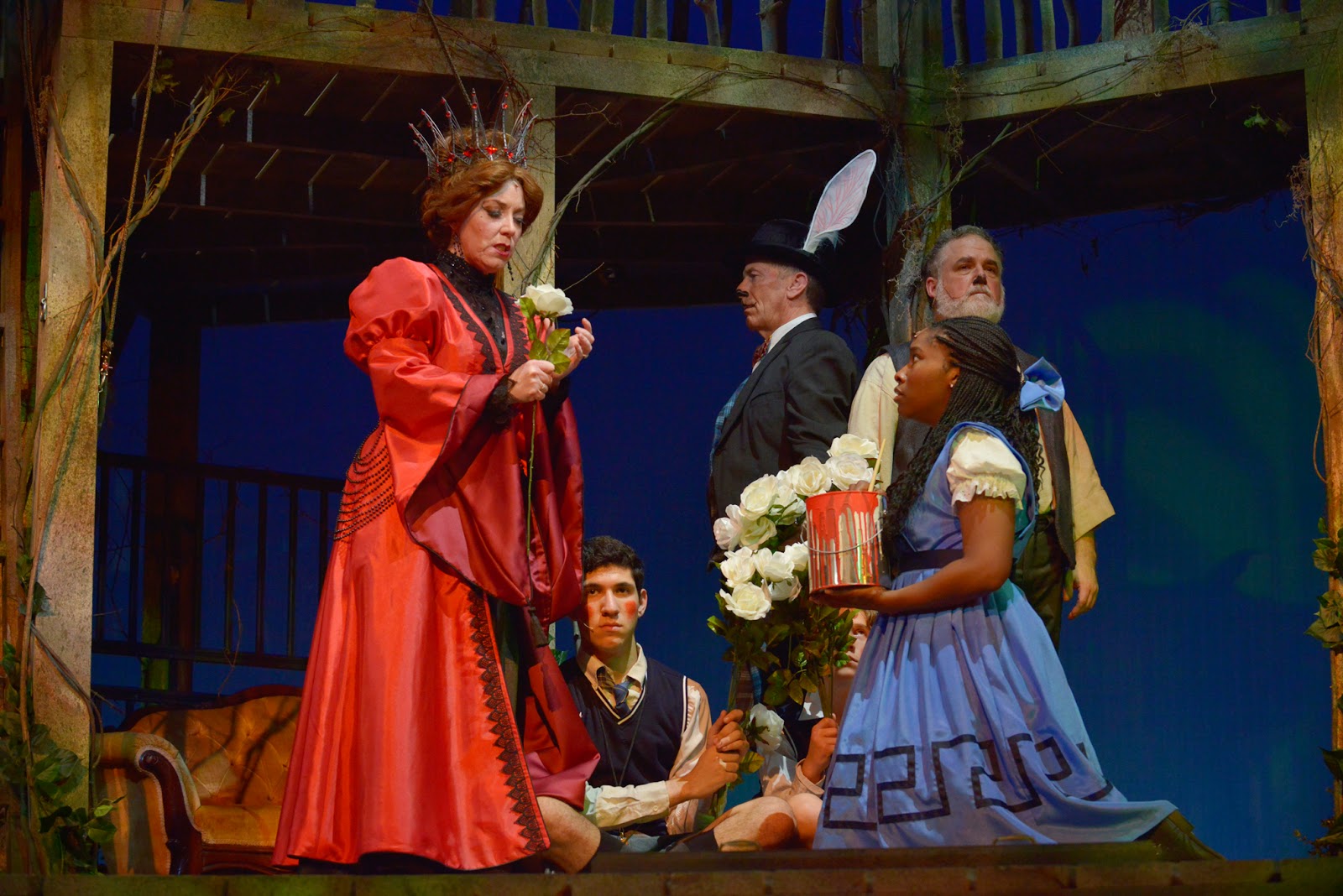 Barbato’s version departs from Carroll’s in other ways.
Barbato’s 13-year-old heroine is emotional and vulnerable. Carroll’s Alice may
be a 7-year-old upper-class Victorian female, but she is as tough as Winston
Churchill in the face of danger. She is never fazed by the behavior of
Wonderland’s rude and self-absorbed characters; her automatic good manners and
perfect poise smooth over any encounter. In fact, it’s vital that the
characters are indifferent to Alice. She has to take her own fate in hand, and
she does. In contrast, Barbato’s play turns the Dormouse, the White Queen, and
even the Red Queen (“Off with their heads!”) into nurturing Montessori
teachers, concerned with comforting and reassuring an upset Alice. Furthermore,
whereas mathematician and logician Carroll uses the rules and pieces of games
(cards, croquet, and chess) to supply a firm scaffolding for his witty chaos,
Barbato eschews game structure for the biological imperative: grow or die.
Barbato’s version departs from Carroll’s in other ways.
Barbato’s 13-year-old heroine is emotional and vulnerable. Carroll’s Alice may
be a 7-year-old upper-class Victorian female, but she is as tough as Winston
Churchill in the face of danger. She is never fazed by the behavior of
Wonderland’s rude and self-absorbed characters; her automatic good manners and
perfect poise smooth over any encounter. In fact, it’s vital that the
characters are indifferent to Alice. She has to take her own fate in hand, and
she does. In contrast, Barbato’s play turns the Dormouse, the White Queen, and
even the Red Queen (“Off with their heads!”) into nurturing Montessori
teachers, concerned with comforting and reassuring an upset Alice. Furthermore,
whereas mathematician and logician Carroll uses the rules and pieces of games
(cards, croquet, and chess) to supply a firm scaffolding for his witty chaos,
Barbato eschews game structure for the biological imperative: grow or die.
That said, perhaps imposing a coming-of-age plot on Alice
was the best option open to playwright and adapter Barbato. It is a
time-honored story format that works well on stage, with child protagonists
engaging in struggles that move them from ignorance into knowledge. The
Wheelock Family Theater has a strong history of producing such plays. Recent
seasons have included The Miracle Worker, The Secret Garden, and Anne of Green
Gables: all of these stories center on girl protagonists who overcome trauma in
order to reach self-determination. Alice acquires power too, regulating her size
to suit the situation and finally reaching the garden that is her goal. Barbato
makes good use of these factors—in one effective scene a long skirt is unfurled
from the top of the set and Alice pops up above it, suddenly 20 feet tall. At
the end of the play, Alice herself creates the garden she has been desiring by
imagining it—child actors’ flower bud hats suddenly sprout outsized bright
flowers. “The garden is all around you,” Alice learns. “Nothing is impossible.”
These are fine lessons for children, and Barbato is to be applauded for
including them.

Still, it must be noted that some children like their Alice
“real.” In a post-show discussion, about 20 children crowded the front rows,
eager to question the playwright. The first asked, “Why did you change Alice
up?” Barbato answered that he had chosen the parts he liked best from the Alice
books and movies and made that into a new play. Another question followed: “Why
didn’t you just make the play out of the book?” Barbato replied that it
wouldn’t have been any fun for the script to tell the same story as the book.
“But some plays do,” the child insisted. Other questioners asked why some
things were left out of the stage adaptation, and why characters from Through
the Looking-Glass were mixed in with a mostly Wonderland-inspired play. The
children debated Alice’s age: “She’s ten.” “No, seven and a half!” “No, she’s
about five!” and wanted to know the actors’ ages. It turns out that several of
the “flower buds” (some as young as nine) were products of Wheelock’s acting
programs for children. The age of the woman playing the Cheshire Cat was a big
surprise. Julia Talbot’s movement and acting skills would be impressive in an
adult, but she’s only 14, another Wheelock acting alum.
Other performance standouts: Jenna Lea Scott, delightfully
funny as the Frog Footman; Russell Garrett, who brought the whimsical polish of
the British Music Hall tradition to the role of the Mad Hatter; and Aubin Wise
as the White Queen—her gospel-diva singing has no logical connection to the
setting, but she’s such a pro that it is a joy to go wherever she leads. The
Duchess (Robin Long) and the Cook (Alexandra Nader) convulsed the audience with
housekeeping so crazy that it turns their baby into a pig! Finally, Elbert
Joseph as the speaking part of the Caterpillar (four other actors played his
lower segments down a spiral staircase) haughtily interrogates Alice in
dialogue straight from the Carroll text. Actors, musicians, designers, and
production staff bring energy and polish to this production of a new work.
Alice’s score, written by Lesley DeSantis, dutifully samples
cabaret and gospel styles. The production’s performers generally deliver the
tunes via the now declamatory Broadway mode: enthusiasm trumps nuance. It did
not help that during the first act the voices of the singers were amplified to
the point of pain. The volume was turned down in act two, which at least made
listening more comfortable. Aubin Wise’s beautiful voice and expert delivery
stood out, as did the antic vocal turns of Tweedle Dum and Tweedle Dee (Noah
Virgile and Dashiell Evett). Pianist Robert L. Rucinski’s versatile ensemble
was excellent throughout, accompanying the singers with tact and steadiness.
The production I attended drew an impassioned young
audience, in the know about Alice and more than ready to be thrilled by a
retelling of her story. The widespread graying of the theater-going demographic
is not apparent at the WFT, where the majority of the people onstage and in the
audience are, as Shakespeare would say, in their salad days. If nothing else,
this Alice confirms something that we tend to forget at our peril—that theater
is a special enthusiasm of the young.


