Showing posts with label theatre. Show all posts

Friday, July 24, 2015

WFT's new Director of Education: Lloyd Woodcock


WFT is pleased to welcome Lloyd Woodcock to the Wheelock community as Wheelock Family Theatre’s new Director of Education. Lloyd began on July 1 and already has endeared himself to students, parents, and teachers alike. Prior to WFT, he worked with the celebrated “TADA! Youth Theatre” in New York. As the former Theatre Coordinator of the New York City Department of Education’s public schools, Lloyd oversaw multiple programs and collaborations, including those with the Shubert Foundation and Music Theatre International Broadway Jr.

Thursday, April 16, 2015

**AUDITION CALL FOR TEEN ACTORS 14-18**

Raising The Bar: Exploring The Actor's Process


TEEN ADVANCED PERFORMANCE INTENSIVE

Wheelock Family Theatre is holding auditions for teens with prior training and performance experience committed to deepening their acting skills and knowledge of the craft.  A limited number of admission slots are available on a rolling basis.  Those actors selected for this program will immerse themselves for two weeks in intensive advanced theatre training.

 Through challenging exercises and workshops in vocal, movement, and character work, and exploration of scenes from outstanding plays, students will experience the actor's process in-depth. This unique program culminates in a Showcase on our WFT Mainstage.


*PROGRAM HIGHLIGHTS: *Specific Individualized Attention and Feedback -*Intensive Ensemble Training  -*Building Core Set of Acting Tools Vital To Every Actor’s Success-  *Breaking through Individual Acting barriers/Issues  -*Teen actors stretch and challenged to go out of their “comfort zone” to take acting to a higher level

 
*PROGRAM DATES: Aug 3 - Aug 14, 2015 (Mon.-Fri.)

Hours: 12:00-6:45pm 

Location: Wheelock Family Theatre, Boston

Main Stage Showcase: Friday, August 14 at 8:00pm.


*AUDITION DATES:

TUESDAY, APRIL 21  (4-7pm)

SUNDAY, APRIL 26   (1-4pm)

(Alternate audition times may be scheduled if necessary)


To schedule an audition, please email your arts resume and a note of interest to:  Fran Weinberg,  Director

WFT Teen Advanced Performance Intensive


*AUDITION REQUIREMENTS: Two contrasting monologues from plays, one comedy and one drama, totaling approximately three minutes. One of the two pieces should be from either: a classical play, any play that emphasizes heightened language, or a play written before 1960.

Tuesday, March 10, 2015

A YOUNG CODA ACTOR SHARES HER PERSPECTIVE

by Ingrid Jensen O’Dell

Ingrid Jensen O’Dell is an 8th grade student at Harborlight-Stoneridge Montessori School.  In The Taste of Sunrise Ingrid plays a student at the school Tuc attends. She is the daughter of WFT Inclusion Coordinator Kristin Johnson


Being in a unique show like The Taste of Sunrise is certainly an honor. As a Child of Deaf Adults, a CODA, I can relate to this play and some of its characters. One hearing character in the play, Maizie, is a CODA. In one scene she says that she can hear and speak, but she is Deaf inside. Being Deaf inside to me is having Deaf memories, having Deaf characteristics, or placing myself into the category of Deaf people. That is something that I can relate to very much.

My time is not spent entirely with Deaf people, or with hearing; half of my time I am with hearing people, and the other half I am with Deaf people. I am comfortable with that, because I can fit into hearing and Deaf culture as a whole. Maizie does not like being part of two worlds. She would rather be in one world, the hearing world. To me, it is not a scenario of two worlds; it is simply one world, with Deaf and hearing together. I feel that I am not part Deaf and part hearing, but a swirl of both. I cannot say that I would rather be Deaf or be hearing, because I am already both, and I will forever be both. In the past, when I have told someone that my parents are Deaf, that person would usually act surprised, but in a nice way. There have been a few people that have felt sorry for me, and would apologize for my having Deaf parents. When I heard what those few people said, I felt, in a way, insulted. Deaf parents are not inadequate, not in the slightest. If you discredit Deaf culture, you are doing so to me, and other CODAs.

Deaf and hearing people are basically the same, but there are some differences. Deaf people notice more things visually, because they cannot hear what is going on around them. Their loss of hearing enhances their other senses, like sight. Hearing people can see and hear, so these senses are about equal. I have characteristics of a Deaf person, for instance, the one I just described. When I am watching a movie in a theatre, I often feel lost and confused, because there are no captions. To get people’s attention, I tend to tap them on the shoulder or try to get their attention without speaking. I read quickly because I am used to reading the captions on television or movies, which shift very quickly.

There are a lot of bonuses with having Deaf parents. I can play loud music; they won’t complain. I can sing as loudly and as obnoxiously as I want; they won’t complain. I can pretend to be Deaf. I can convince people that I am. I can talk on the phone endlessly; they won’t get annoyed. I can listen to music on the radio in the car, and they won’t be bothered. Occasionally, my mother will put on her hearing aid and listen to the music as well. When I’m not sure if my mother has her hearing aid on, I shout or talk loudly to see if she will react. It often surprises me when she does react, because I’m not used to it.

There are some things that aren’t great, like when the batteries in the smoke alarm are low and I have to hunt all over the house to stop the beeping. When I’m in the car and the turn signal is on and beeping when it shouldn’t be, I tell my parent that it is on. When my dog is barking, or the microwave is making weird sounds, I tell my parents. I am not told to tell them when these things happen, but I tell them because it bothers me, or I feel that I need to inform them.

All in all, Deaf people and hearing people are the same, but different. I am a CODA, and I am proud to be one. There is nothing wrong with being Deaf, having Deaf parents, or even just knowing Deaf people. If I ever have children, I will keep them, unlike Maizie, and I will teach them sign language. I will never be able to ignore my Deaf self, not that I will ever want to. I am Deaf and hearing, and very proud to be both.

Tuesday, December 23, 2014

The year was 2012, and the show was OZsome!

The Wizard of Oz at Wheelock Family Theatre in 2012. 
Munchkins backstage with Arthur Wheelock, Will Christmann, Isabelle Cotney, Katie Gustafson, and Samil Battenfeld. I don't think they are "munchkins" anymore!


Thursday, October 23, 2014

"Alice" Grows Up in New Musical Wonderland


Arts Fuse 10/22/2014

Andrew Barbato’s musical turns the Dormouse, the White Queen, and even the Red Queen (“Off with their heads!”) into nurturing Montessori teachers, concerned with comforting and reassuring an upset Alice.


By Lin Haire-Sargeant

There is much to enjoy in the Wheelock Family Theater’s Alice, a musical interpretation of Lewis Carroll’s high Victorian children’s books Alice’s Adventures in Wonderland (1865) and Through the Looking-Glass and What Alice Found There (1872).

Talented 24-year-old playwright Andrew Barbato has imagined an entertaining coming-of-age story for Alice (ably played by Maritza Bostic). It’s the morning of her 13th birthday, and Alice dreads attending a party where she must mind her manners and play the piano for guests. Her imaginary world, Wonderland, is her only escape. As designed by Matthew T. Lazure, Wonderland’s vertical stage-filling maze of wooden trunks, platforms, ladders, and staircases contains plenty of places for Alice to hide, fall down rabbit holes, and change sizes. Beloved characters from the books (The Queen of Hearts, The White Queen, Tweedledee and Tweedledum, the Cheshire Cat, and many more) are arranged around the set like statues that come alive and interact with Alice. In the story that follows there are lively song-and-dance numbers; there are tears; there is laughter. As the playwright explained in a post-show discussion, each scene teaches Alice a different lesson about growing up. By the end of the play, Alice has been successfully coaxed to attend her party and to accept her impending womanhood.

But there’s a problem.

Lewis Carroll didn’t want Alice to grow up.

Alice’s adventures were told by Charles Dodgson (pen name Lewis Carroll) to 10-year-old Alice Liddell and her two sisters on a series of idyllic boat-ride picnics on the River Thames in the summer of 1862. He imagined for the children a glimmering alternative world, viewed through the golden gauze of summer afternoons. Alice’s father Henry Liddell was dean of Christ Church at Oxford University, where Dodson taught mathematics. The writer cherished his friendship with this distinguished family. Though shy and uncomfortable with grownups, in the company of little girls he blossomed. Adept at magic tricks, comic verse, and genteel, childish puns, his relationships with his numerous “child friends” were correct but intensely loving. It was not thought odd or alarming at the time that a grown man would be fixated upon little girls; indeed, all the evidence confirms that Dodgson never committed an impropriety. But he remained an unmarried bachelor all his life. Is there anyone less likely to create a story celebrating maturity, aside from J. M. Barrie, creator of Peter Pan? Alice cannot grow up any more than Peter. Carroll’s delightful imaginative world depended on Alice NOT celebrating the birthday that would take her to womanhood.

In addition, anyone who tries to faithfully adapt the Alice stories for dramatic presentation encounters a formidable obstacle: drama depends on development. Films can count on spectacle; a few successfully reproduce the static anarchy of the Alice books, such as Disney’s cheerfully nonsensical 1951 animated Alice in Wonderland and, on a darker note, Czech Jan Svankmajer’s surrealist 1988 stop-motion Alice. But a theater production is more earthbound—it has to get somewhere. But Carroll’s books are word-art. On the page, the transformations Alice goes through can happen as quickly and as effortlessly as a child can imagine—there is no worry over emotional impact or symbolic meaning. Many of the originals for Carroll’s poetic parodies can be known only through footnotes; others, like the tail-shaped lyric “A Mouse’s Tale,” must be seen on the page to be appreciated. This kind of intimate charm is not stageable.
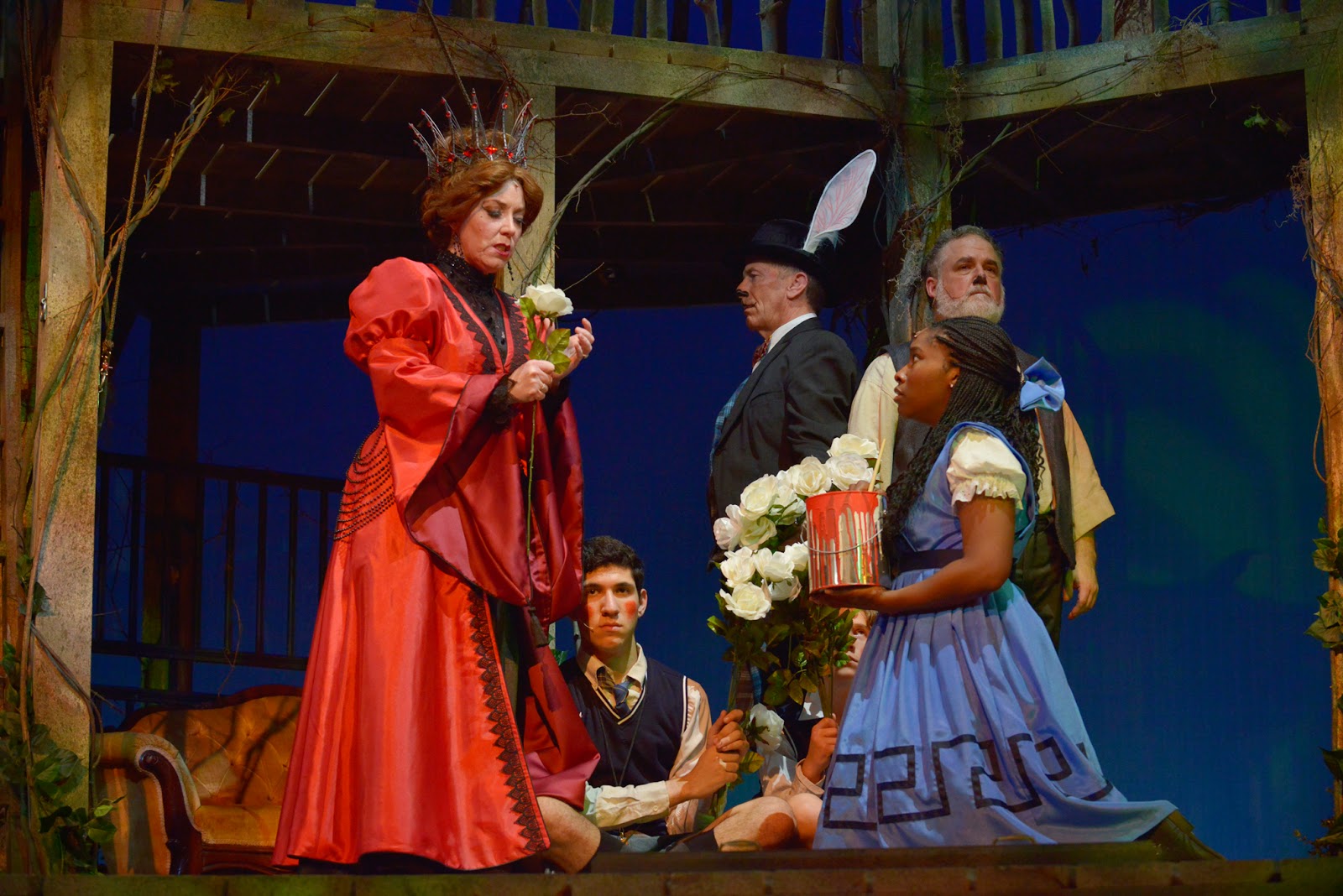
Barbato’s version departs from Carroll’s in other ways. Barbato’s 13-year-old heroine is emotional and vulnerable. Carroll’s Alice may be a 7-year-old upper-class Victorian female, but she is as tough as Winston Churchill in the face of danger. She is never fazed by the behavior of Wonderland’s rude and self-absorbed characters; her automatic good manners and perfect poise smooth over any encounter. In fact, it’s vital that the characters are indifferent to Alice. She has to take her own fate in hand, and she does. In contrast, Barbato’s play turns the Dormouse, the White Queen, and even the Red Queen (“Off with their heads!”) into nurturing Montessori teachers, concerned with comforting and reassuring an upset Alice. Furthermore, whereas mathematician and logician Carroll uses the rules and pieces of games (cards, croquet, and chess) to supply a firm scaffolding for his witty chaos, Barbato eschews game structure for the biological imperative: grow or die.
That said, perhaps imposing a coming-of-age plot on Alice was the best option open to playwright and adapter Barbato. It is a time-honored story format that works well on stage, with child protagonists engaging in struggles that move them from ignorance into knowledge. The Wheelock Family Theater has a strong history of producing such plays. Recent seasons have included The Miracle Worker, The Secret Garden, and Anne of Green Gables: all of these stories center on girl protagonists who overcome trauma in order to reach self-determination. Alice acquires power too, regulating her size to suit the situation and finally reaching the garden that is her goal. Barbato makes good use of these factors—in one effective scene a long skirt is unfurled from the top of the set and Alice pops up above it, suddenly 20 feet tall. At the end of the play, Alice herself creates the garden she has been desiring by imagining it—child actors’ flower bud hats suddenly sprout outsized bright flowers. “The garden is all around you,” Alice learns. “Nothing is impossible.” These are fine lessons for children, and Barbato is to be applauded for including them.


Still, it must be noted that some children like their Alice “real.” In a post-show discussion, about 20 children crowded the front rows, eager to question the playwright. The first asked, “Why did you change Alice up?” Barbato answered that he had chosen the parts he liked best from the Alice books and movies and made that into a new play. Another question followed: “Why didn’t you just make the play out of the book?” Barbato replied that it wouldn’t have been any fun for the script to tell the same story as the book. “But some plays do,” the child insisted. Other questioners asked why some things were left out of the stage adaptation, and why characters from Through the Looking-Glass were mixed in with a mostly Wonderland-inspired play. The children debated Alice’s age: “She’s ten.” “No, seven and a half!” “No, she’s about five!” and wanted to know the actors’ ages. It turns out that several of the “flower buds” (some as young as nine) were products of Wheelock’s acting programs for children. The age of the woman playing the Cheshire Cat was a big surprise. Julia Talbot’s movement and acting skills would be impressive in an adult, but she’s only 14, another Wheelock acting alum.

Other performance standouts: Jenna Lea Scott, delightfully funny as the Frog Footman; Russell Garrett, who brought the whimsical polish of the British Music Hall tradition to the role of the Mad Hatter; and Aubin Wise as the White Queen—her gospel-diva singing has no logical connection to the setting, but she’s such a pro that it is a joy to go wherever she leads. The Duchess (Robin Long) and the Cook (Alexandra Nader) convulsed the audience with housekeeping so crazy that it turns their baby into a pig! Finally, Elbert Joseph as the speaking part of the Caterpillar (four other actors played his lower segments down a spiral staircase) haughtily interrogates Alice in dialogue straight from the Carroll text. Actors, musicians, designers, and production staff bring energy and polish to this production of a new work.

Alice’s score, written by Lesley DeSantis, dutifully samples cabaret and gospel styles. The production’s performers generally deliver the tunes via the now declamatory Broadway mode: enthusiasm trumps nuance. It did not help that during the first act the voices of the singers were amplified to the point of pain. The volume was turned down in act two, which at least made listening more comfortable. Aubin Wise’s beautiful voice and expert delivery stood out, as did the antic vocal turns of Tweedle Dum and Tweedle Dee (Noah Virgile and Dashiell Evett). Pianist Robert L. Rucinski’s versatile ensemble was excellent throughout, accompanying the singers with tact and steadiness.

The production I attended drew an impassioned young audience, in the know about Alice and more than ready to be thrilled by a retelling of her story. The widespread graying of the theater-going demographic is not apparent at the WFT, where the majority of the people onstage and in the audience are, as Shakespeare would say, in their salad days. If nothing else, this Alice confirms something that we tend to forget at our peril—that theater is a special enthusiasm of the young.

Friday, December 13, 2013

‘Life’ as we know it reimagined as a radio play - by Joel Brown. Boston Globe

For most people, “It’s a Wonderful Life” is a black-and-white holiday movie that pops up on TV to offer a glimpse into American life more than half a century ago. “It’s a Wonderful Life: A Live Radio Play,” adapted by Joe Landry from the 1947 Frank Capra classic, adds another layer — a look behind the scenes of a period radio performance of the story.
The Wheelock Family Theatre production that begins performances Friday makes the most of that play-within-a-play angle.
Under the direction of Wheelock producer Wendy Lement, five actors, three singers, a pianist, and two Foley artists bring to life the story of small-town banker George Bailey, whose attempts to be a good man have ended in despair. At this late date, it’s hardly a spoiler to say that on Christmas Eve, with the help of a sympathetic angel, George learns that his sacrifices have not been for nothing, and that he is the richest man in town in all the ways that matter.
Wheelock audiences won’t see the snowy streets of Capra’s fictional Bedford Falls, though. Instead they’ll be looking into a 1940s radio studio, complete with period costumes and microphones. The Wheelock actors play radio performers who in turn play the characters in “It’s a Wonderful Life.”
Acting with the voice alone is enough of a challenge, says actor Dan Bolton, who plays George. “It really does make you focus on the words and where the important idea in each word is,” he said.
Bolton credits Lement with helping him find his character arc, how George changes from scene to scene and from the beginning of the play to the end. “She’s been good at giving me guideposts as to, here’s where he’s sassy, here’s where he’s desperate, here’s where he’s right on the brink, and here’s where it all comes together for him.”
George can be a complicated guy, he says. “For instance, the scene where he watches Mary as an older librarian without George in her life, and her life is completely empty. It’s not necessarily that he feels bad for Mary, but he feels like he’s been a jerk, because he’s let the love of his life get away, and he’s let her life be empty because he wasn’t there.”
Bolton and Liz Hayes, who plays Mary Bailey, only have to play their own characters. But the other Wheelock actors — Barlow Adamson, Johnny Lee Davenport and Marina Re — play the rest of the inhabitants of Bedford Falls. Or more accurately, each “has an actor that they’re playing, who then is playing all of these different roles” on the radio, Lement says. And things can get really complicated when two of those roles end up in conversation. “It’s very fun. They’re actually having conversations with themselves and finding ways to make that clear and make it come alive.”
Lement and company have created nonverbal scenarios to give life to each of the radio performers, too.
“Like, one of the singers who’s young has a crush on one of the lead actors and runs over and gives him a Christmas gift,” Lement says. “And the woman he’s dating, who’s also one of the lead actors, sees that and gets angry. These are moments we’ve put in to try to create this as a world itself.”
Bolton says the radio cast reaches a little epiphany of its own by the end.
“There’s this great moment where the five of us look over to the Foley artists and the singers and almost take this collective sigh, like saying, ‘Wow, what a story we’ve told,’ ” Bolton says. “It’s actually one of my favorite moments in the show. They’re playing ‘Auld Lang Syne’ behind it, but it’s not sappy or sentimental, it’s just very present and very real, and every time we get to that moment, I love it. We all put on this really good story, and we all lived the message that was in this story.”
There are at least two other productions of Landry’s “It’s a Wonderful Life” in the state this holiday season: through Dec. 29 at Shakespeare & Company in Lenox, where Landry will appear for a talkback after Sunday’s matinee (www.shake
speare.org), and at the Marblehead Little Theatre through Dec. 22 (www.mltlive
.com). It appears to be a holiday winner for theater companies.
So is this “Wonderful Life” the beginning of a new Wheelock holiday tradition?
“It could be,” says Lement. “We’ll actually save the set pieces in case we decide to do it again. And it might not be every year — but it might be. We’ll see what the response is.”

Sunday, November 10, 2013

Dear Bilbo Baggins

I hope this letter finds you happy and healthy. Let me preface my note with this: I am not one to pine over others. I have never been a copy cat. On the contrary, I pride myself on being an individual! I commit my time and energies to the exploration of my inner workings and I am all about SELF EXPRESSION. Emulation makes me cringe.

And yet...

Every Friday, Saturday and Sunday I find myself dressing in your clothes. I find myself snooping around your hobbit hole. And that's only the start of my obsessive behavior. Observe me long enough and you'll find me trying to relive your amazing adventures. It's obsessive and it's weird and I had to write to you to confess. I've even grown mutton chops in an effort to feel more like you. Did you even have mutton chops? I digress...


The actual point of this letter is to thank you. My obsession with you (and with the events of your life) has actually been revelatory. Below, I have listed my top three favorite lessons I have learned from you. I hope you find this charming rather than freaky.


Baggins Life Lesson # 1

~”There is a lot more in you than you have any idea of”~

I'm pretty sure Gandalf says that to you. I think there might be more within me than I know. I think there might be more within all of us. Bilbo, you have inspired me to throw myself into situations that will test my character and reveal my true potential. #YOLO


Baggins Life Lesson # 2

~”Go forward. Only thing to do.”~

When you found yourself alone in a dark and wet cave, you made the decision to continue moving forward. That led you to Gollum, and eventually to THE RING! I guess you never know how close you are to finding your personal treasure and while the path may seem dark and wet, you have GOT to keep going. To quote FLORENCE + THE MACHINE: “It's always darkest before the dawn”.


Baggins Life Lesson # 3

~”If all of us valued food and cheer above hoarded gold, it would be a merrier world” ~

I mean, COME ON. Can't you just taste the truth in these words? It sometimes (always) feels like the green paper floating around this country CONTROLS everything. Let's just take a second to bake an apple pie and make merry with our neighbors!

Pie Crust: $2.50

Apples: Free (because in this fantasy I have an apple tree in my backyard)

Bag of Ground Cinnamon: $2.90

An evening full of laughter and cheer: PRICELESS

 
Well Bilbo, I guess this is where I stop. Thanks again for teaching me some things. If you ever find yourself in Boston or New York, please let me know. I'd love to get tea.


Love Always,
Andrew Barbato
 

Tuesday, September 25, 2012

Wheelock Family Theatre: Anne Shirley


"Anne of Green Gables" was first performed at Wheelock Family Theatre in 1989; the production having been seen on Prince Edward Island by Grace Napier and Bill Monnen and suggested as a "good fit" for WFT. Devon Sorvari was Anne Shirley. Ms. Sorvari has gone on to pursue a career in acting, having performed on stage, in film, and for television. The Sorvari family was involved with WFT for years. Besides Devon's work as a performer, Ann Sorvari developed many of the WFT Study Guides.

To check in on Devon, visit her website here: Devon Sorvari

Danielle Perry played Anne Shirley in the 1999 production at Wheelock.

This year's production of "Anne of Green Gables" features Jennifer Beth Glick as Anne Shirley. Jennifer is excited, having wanted to play the role since the last time it was produced at WFT in 1999.
Patrons of WFT musicals may remember Jennifer in "The Secret Garden" as the kind maid of Misselthwaite Manor, Martha, and in "Seussical" as the bird of slight feathers, Gertrude McFuzz. Jennifer has a number of songs on YouTube and you can hear them here: Jennifer Singing